
Plotting With Your Own Enneagram Type
Your type is what you know

I love using the Enneagram to write characters because I tell myself I can pull a rich character off the shelf, plug them in, and watch them climb that plot arc like a champ.
The truth is different from the fantasy. Like any author, my characters are very deeply affected by my own Enneagram type.
So, while the sapphic witchy novel I am currently writing was supposed to feature an Enneagram Three protagonist, she turned into an Enneagram Eight on me, because I myself wing Eight.
It doesn’t matter that I tried my darndest, plotting out her successes and greatest fears around what a Three might feel. Nope.
I see this in characters frequently. For example, so many things about Holly Black’s character, Cassel Sharpe, in The Curse Worker series seem set up to be a Nine (I don’t want to say all of them because of the spoiler potential in a wonderful series). At the same time, other aspects scream Enneagram Four to me.
The writer’s type usually dominates. There’s no point in fighting it. Thank goodness, every type has aspects of every other type, so we can still construct a self-consistent character even when we set out to portray one type and end up reflecting our own.
Every one of Terry Pratchett’s Discworld books shows the holy merits of strength and protection (Enneagram Eight), as opposed to the weakness and frivolity of erudite esoteric eccentrics (how an Eight may feel about their dissolution type, the Five). For example. But we don’t feel any poverty of character in his stories.
Authors will always put their own types into their characters, even if the writer intends to portray them as different Enneagram types. Whenever my character has to make a choice or react, my intuition comes into play. No matter how hard we try, we see our characters through our own enneagram filters.
This is true of one of my favorite comfort reads (or comfort listens, as I enjoy the rich narration of Will Patton), Maggie Stiefvater’s four-book series, The Raven Cycle. Stiefvater does an admirable job portraying differing personality types, and it’s perfectly reasonable that her own type (she’s a self-professed Enneagram Eight) creeps in.
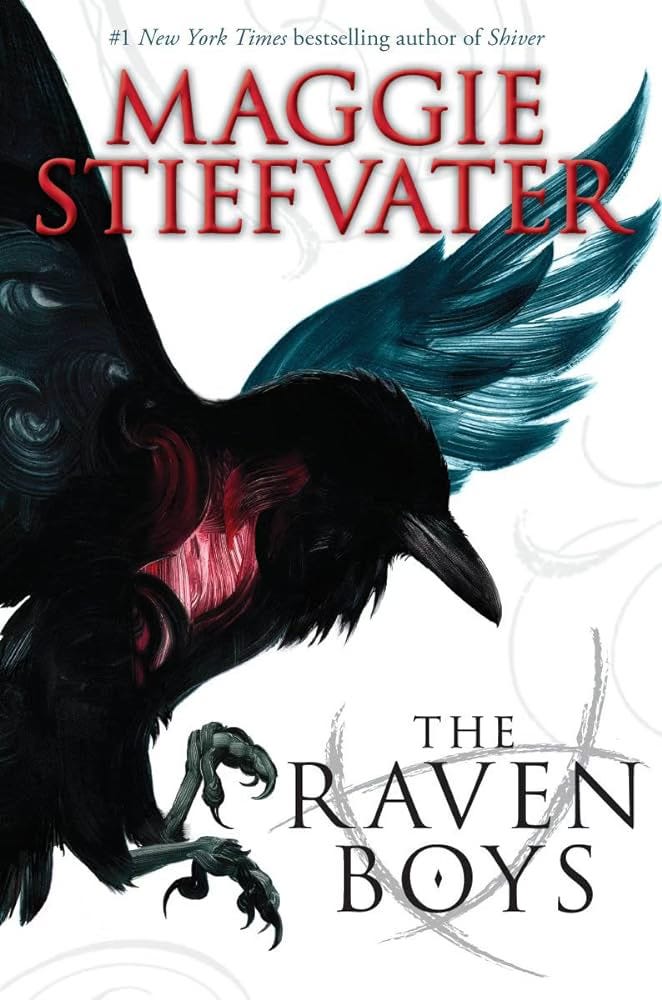
I don’t want to spoil it for anyone—the first book was only published in 2012—but one of the central characters, Adam Parrish, is sometimes a Five and sometimes an Eight. His stubborn pride above all and clinging to independence is too central a driving force for a Nine, and he’s far too forgiving to be a One. He fears he is not competent enough, so he fights for his sovereignty. But the choice he makes at the climax of the story feels like it would be a tragedy for a Four, too easy for a Nine, in keeping with a Five, and unbearable for an Eight.
Adam’s choice leads to a festering conflict with the central character, Gansey, a kingly Eight celebrated as the worthy center of his circle.
Gansey is the leader, admired by all. He is adored by Ronan Lynch, the well-portrayed Enneagram Four, sexual subtype, in what feels like a slightly indulgent bit of wish fulfillment. An actual Four with a sexual subtype would have a hard time tolerating the drive towards command of an Eight. I don’t begrudge it of Stiefvater, though—creativity is one of our best tools for healing and making whole our psyches, after all.
How does the author’s Eightness manifest in the plot? It’s a sacrifice-yourself-for-the-greater-good growth cycle.
Don’t worry, it has a happy ending.
As Enneagram Eight integrates towards the Two, this growth arc makes sense. It makes her character arcs especially satisfying.
So, when you’re writing your next novel, it doesn’t hurt to remember what your own type is when you are charting and recording your character’s responses to stress and fulfillment.
But don’t worry about it too much, either.
I'm curious if when we read books, do we have a bias to seeing our type characteristics in the characters and if they are different to our type, do we try to see our type in them to feel a sense of connection?